



April 11th, 2014
11 Apr 2014 · page 351 of 1306
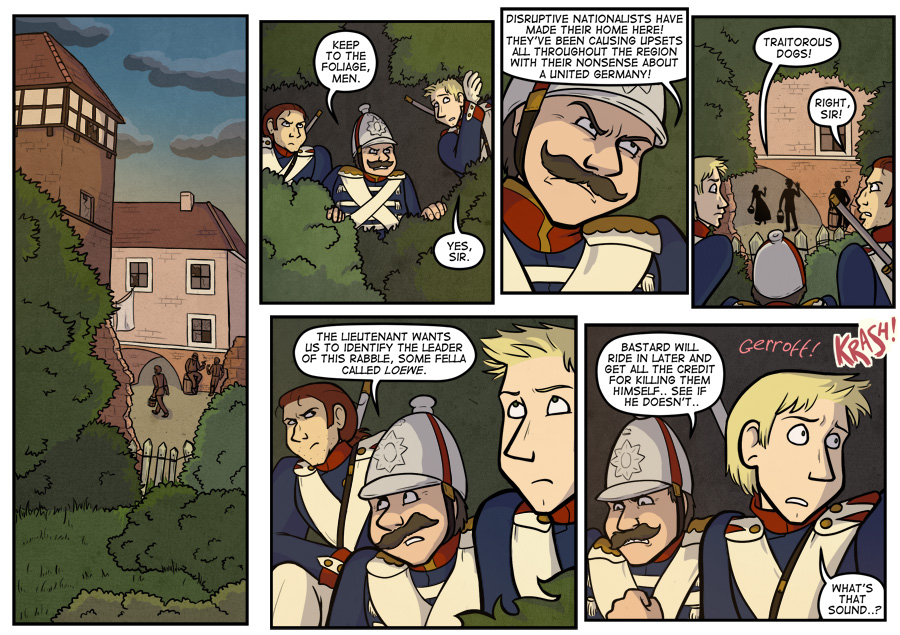
Trouble on the way.
Cast: Dominik Voss, Heinrich Wolfe
Comments (31)
Events

ThoughtBubble
14 Nov 2026 – 15 Nov 2026
Harrogate Convention Centre
Manchester Megacon
31 Jul 2027 – 1 Aug 2027
Manchester Central





There it is! Panel 1 (left) and Panel 4 (top right).
I see what you did there. Thank you, Kate!!!!!
"Keep to the foliage men while I wear my shiny, shiny helmet that will in no give away our position."
Honestly, it's amazing how many armies did not see this as a bad idea for uniforms up until WWI when those helmets became perfect targets for snipers.
Well that's just it. It wasn't shown to be a bad idea before that point, and much of the uniform had little to do with warfare, and much to do with showing which side you were fighting on and how important you are. And status was everything until people were once again reminded that death makes everyone equal, and that the quickest way to put an army into disarray is to take out the one leading it. And with sniper rifles starting to become a viable weapon, soldiers of all ranks learned of the word subtlety.
The Confederacy had some truly effective sniper rifles in the War Between the States (which is, admittedly, thirty-some years later) - my favourite Last Words are "Nonsense! They couldn't hit an elephant at this -"
General John Sedgwick, Battle of Spotsylvania Courthouse, 1864
The Confederacy just had good snipers.(or the period correct term sharpshooter) The thing that made them all the more deadly was the the development of the Sharps rifle. Once a Confederate marksman got used to a captured Sharps rifle he could probably get 1 confirmed kill for every bullet he had.
The rifle that got General Couldn't-Hit-an-Elephant was, i think, the Confederacy's own rifle - with a scope the length of the barrel, and a hexagonal bore instead of rifling. (Glock handguns have hexagonal {9mm} or octagonal {.45} bores, incidentally.)
It was superior to the Sharps over distance.
Well... sort-of. Bow and arrow can find a flashy target much more easily than a drab one as well. Having uniforms was a way of saying 'more money, more people, more supplies' in times when siege warfare was common and numbers and supplies were more relevant to who won and lost than how many could be seen at a distance or picked off by snipers. In theory if not always in practice. That, and for some time 'honourable warfare' meant not attacking civilians, which meant uniforms were required.
The old British Army red uniform was a bit of a sniper-magnet too, as they found out during the Indian Mutiny and the Boer War. And yes, there was a 40-odd year gap between those two conflicts- the lesson took a while to sink in.
US Continental Army sharpshooters made that pretty clear during the Revolutionary War. Officers riding around on horseback issuing orders while decked out in what could pass for a ceremonial uniform made easy pickings for the guy sitting up in a tree with his (what was at the time considered long range) hunting rifle.
Interestingly enough, Khaki was supposed to become the official campaign uniform before the First Boer War, but most regiments just ignored it and the few who adopted it stuck so much bumf on it it may have well have been bright red.
The helmet is so bright and shiny so that all the fire will be drawn towards the only bit of flesh in the entire detachment that has anything resembling armor protecting it.
To be fair, until rifles became standard issue, being visible to your own troops was more important than drawing fire.
Wow, so we've got two possible sources for Ol' Green Eyes already.
...This could get rough.
First a wolf, then a fox, now a lion....
This is set in Prussia? But the kings of Prussia were all for a united Germany [under their leadership]. I suppose these nationalists could have ideas about Germany led by more democratic forces, which was not rare and would limit any official love for them, but it still jars that Sarge objects 1st to their interest in a united Germany.
Not exactly. The Prussian kings were generally opposed to Austrian influence on the German states, but they have a long history of being less than enthusiastic about accepting the imperial crown, starting with Friedrich Wilhelm IV, who declined it when it was offered to him during the 1948 Revolution, and ending with his brother Wilhelm I, whom Otto von Bismarck had to strongarm into accepting the crown. (Interestingly enough, Bismarck utterly rejected the idea himself at first.) Their father, Friedrich Wilhelm III, repressed the newly-founded fraternities (with their spirit of Pangerman nationalism) in particular (or gave his tacit approval whem Karl Albert von Kamptz cracked down on them). The only criticism you could offer is that 1830 was smack in the middle of a lull in repression of Pangerman nationalists, though considering the French Revolution of 1830 and the Tailors' Revolution in Berlin were going on at the same time, it's not at all far-fetched to suggest that while no concerted action was being taken, incidents such as this one certainly occurred. The opinion that Pangerman nationalism was detrimental to Prussia was certainly not unheard of among conservatives and Prussian patriots (see Bismarck in 1849).
I suspect you mean 1848.
Otherwise this is interesting and do you have book or two to suggest on reading about this era?
Ugh, yes, 1848.
I'm afraid I can't recommend any books on this as it's mostly what I remember from my Berlin public school days and various TV specials on history, refreshed with a binge of the relevant German wikipedia pages.
Fair enough. Thanks!
He's a Loewe not a fightah.....
Loewe is pronounced luh-veh ;)
[https://en.wikisource.org/w...](https://en.wikisource.org/wiki/The_New_International_Encyclop%C3%A6dia/Loewe,_Wilhelm "https://en.wikisource.org/wiki/The_New_International_Encyclop%C3%A6dia/Loewe,_Wilhelm")
That's a pretty huge co-incidence because it's not that person!
Not that much of a coincidence. Loewe is a not really uncommon German surname. Not exactly common, either; but common enough that in the very militarised German state, two significant soldiers with the name Loewe isn't a miracle.
"Gerroff"? Sounds like someone we know just arrived.
On uniforms: I was just reading that Geo. Washington designed a uniform for his Continental army based on the dress of the indigenous people he was fighting in the French and Indian War: linen jackets dyed tan for camouflage, with fringe to indicate rank, and tall leather gaiters to protect legs from brush and snakebite, which apparently was considered a serious risk. No bright colors, nothing shiny, to be provisioned in the same way that gaudier, European style uniforms would be. In some situations tradition dies hard. In other situations, tradition is what dies.
Well, like many traditions, it made sense in the middle ages, where you would either by hit by a lucky shot from the opposing sides archers, or would be in a frantic scrum of close range combat, where you really wanted to make it clear which side you were on so that you weren't killed by your own army.
The we stopped using swords and spears in favour of guns, but people stuck with the old tradition. It took a while to realise that they needed to change, because who doesn't like cool hats?
Actually, it had multiple roles. First, command and control on the battlefields up to the middle of the 19th century were dependent on visual and auditory cues. Troops had to be massed in lines as much the control them as to make them effective in volley fire and the bayonet charge. Things got complicated by the middle of the 19th century due to advancements in both rifled musketry and field artillery. Troops still had to be massed to be controllable on the battlefield, yet were vulnerable to accurate fire in such large visible formations. Colorful uniforms helped to identify units, certainly. Unless you were fighting someone who was using the same colors, which happened often enough. The fancy uniforms also helped moral.
I want to know what European came up with the whole "let's stand in a straight line and take turns taking pot shots at each other" tactic. There had to of been a more sensible way of organizing your troops.
It evolved out of pike formations. They started putting muskets in with the squares (yes, squares) of pikemen. Then they started adding more musketeers and fewer pikemen. The squares became rectangles to better mass the volley fire. The bayonet was introduced, turning every man into both a musketeer and a pikeman.
Until the mid 1800s you couldn't try anything out of formation without risking being run down by cavalry, so they mostly didn't. Around then your average soldier could fire fast enough to counter a cavalry charge with firepower alone, and it all started to change.
So the reason you stood in a line to get shot at was that it was safer than the alternative. Well, the reason /you/ stood in a line was because you signed up and they shoot deserters. That's just why they put you in a line.
green with envy
(apologies to anyone who's said this already)