



Events

ThoughtBubble
14 Nov 2026 – 15 Nov 2026
Harrogate Convention Centre
Manchester Megacon
31 Jul 2027 – 1 Aug 2027
Manchester Central





NOT NOW, THEA
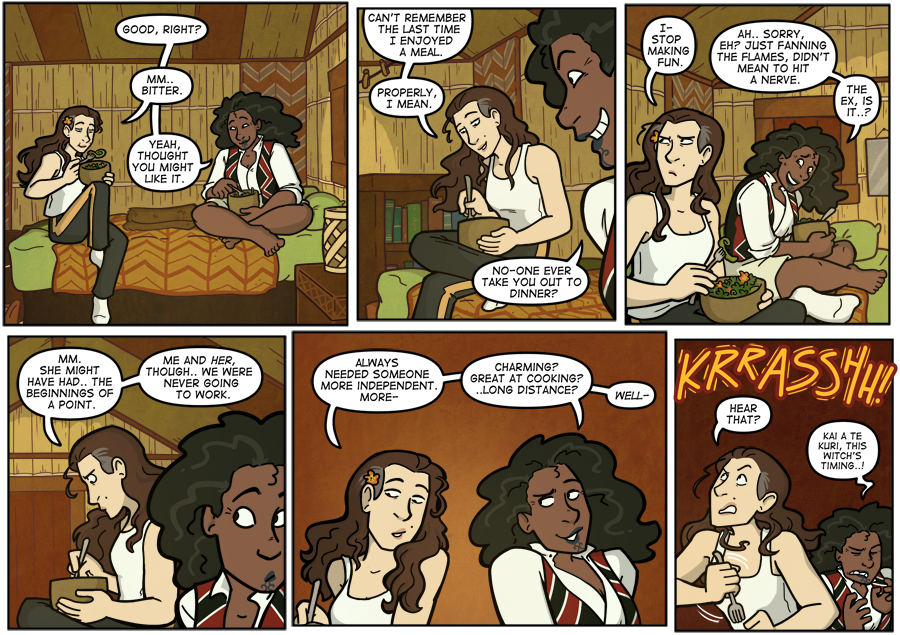
oh tragedy upon tragedies…. You might have to confess to the adventurer during the midst of an adventure, Nyree, oh noooo
Nicola looks so different with her hair down !
Not to mention smiling.
And without the tunic
Google Translate says “kai a te kuri” means “dog food”, which doesn’t seem quite right. Anyone have a better translation ?
that’s right, it’s used as a curse! the internet told me that, and i wasn’t sure, because internet, so i went digging for confirmation. dug up someone cursing their neighbour out on facebook, and a broadcasting standards document that marked it as offensive, both of which felt official enough to me
My dad {who grew in Berwyn, a Chicago suburb, in the Thirties} had an interesting assortment of Yiddish, Polish and Bohemian {second-generation USAian-born} curses.
One of his favourites was a Polish curse {which I have no idea how to spell} that he told me meant “dog’s blood”.
Yes, it is “psiakrew”. Even has a Wikipedia page for it! Very popular in the Witcher 3 game (which I very much prefer with the Polish voiceover).
Thank’ee. Been wondering how that's spelt for about seventy years…
The fun thing about Polish curses is that they’re usually spelled how they’re pronounced (Polish is much more phonetically spelled than English is).
A lot of European curses seem to involve blood from what I have seen (though not European, so I could be completely wrong). French Canadian ones tend to involve more religious terminology. US ones tend to range from religious ones to bodily functions.
I always found the bloody ones funny, as my French to English dictionary actually had several of these in there and it is something not used at all in the US.
I always find what cultures use as curses as interesting as their local folk or fairy tales, as it can say a lot about their culture and what they value. It does make me wonder where the dog food one comes from though.
On a side note, “fudge muffins" is one I find personally amusing, as if anyone asks, you can say “Because they are delicious”. After all, who doesn't want something delicious to relieve their frustration?
The european curses that involve blood are often religious as well, they are often referring to the holy blood of Christ from the crucifixion.
Or possibly parentage….
Interestingly enough, i once read an etymology of various curses, and the all-purpose English {as in “what Brits say when they’re upset} curse “bloody” has nothing to do with red liquid - it’s derived from “by Our Lady”, worn down by time…
What Google’s AI Overview says: “Kai a te kuri" is a strong Māori curse, similar to "bugger" or "fuck," used to express anger or contempt. Its literal translation, "food of the dog," is much weaker than the actual meaning and does not convey the strength of the emotion behind it. In traditional Māori society, boiling a dog's head would have been the ultimate insult because the head is considered tapu (sacred).
Meaning: A very strong curse, similar to "bugger" or "fuck" in English.
Literal translation: "Food of the dog" or "boiled dog's head".
Context: Used to express strong anger, hatred, or a lack of desire to do something. The strength of the expression is tied to the ferocity with which it's spoken.
Shun the clanker! Shun! Shuuuuuuunnnnn…… :p
Considering the number of times Captain Barber has played gooseberry in the past, this is only just and fitting.
“Works every time” except when something interrupts.
By gum, I got lost in the plot and had to go back to reread, and thought I’d be rereading up to the end. I haven’t missed it!
Always the timing
Yeah, your timing could be a bit better, Nyree. 😉
“Ffs, can you try and end us all a bit later? I’m flirting here!!!”
Thea couldnt ye have waited a few more seconds