


September 11th, 2013
12 Sept 2013 · page 266 of 1306
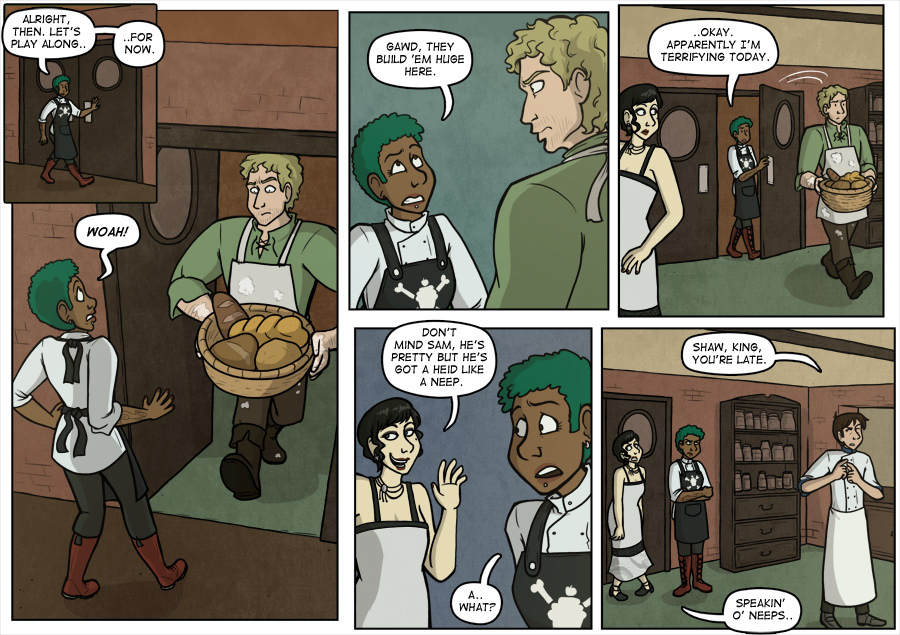
A neep is a turnip.
Cast: Alexa King, Ethan Booth, Gladys Shaw, Samuel
Comments (29)
Events

ThoughtBubble
14 Nov 2026 – 15 Nov 2026
Harrogate Convention Centre
Manchester Megacon
31 Jul 2027 – 1 Aug 2027
Manchester Central





head like a turnip. gotcha.
and a 'heid' is a ?
hoping 'guest' is right and that's a typo - head like a turnip. what does that mean?
Not a typo: it's the Scots word for (or just Scottish-accented pronunciation of?) "head". Gladys has been ostentatiously Scottish since her first appearance.
If you're asking what "head like a turnip" means, you should really be able to figure that one out by yourself. :)
As there is no real way to distinguish between dialects and languages, it is hard to state whether Scots is a different language or not. However, either way it would be correct to term it a Scots word.
For some of the debate on Dialect or Language have a look at [http://en.wikipedia.org/wik...](http://en.wikipedia.org/wiki/Scots_language "http://en.wikipedia.org/wiki/Scots_language")
And for the benefit of spas... what would you think someone meant if they described your head as being like a dense root vegetable.
At least we didn't descend into some of the more bizarre corners of the Scots language...
Yet
I was thinking of things like the discussion noted by Alan Ramsay in 1721...
Oo?
Ay, oo.
A' oo?
Ay, a' oo.
A' ae oo?
Ay, a' ae oo.
Or the classic line from a court transcript "I e' i' a'"...
Z.
I direct your attention to the 1524 ["Monition of Cursing" of the Archbishop of Glasgow](http://www.borderreivers.co.uk/Border%20Life/The%20archbishop's%20cursing..htm "http://www.borderreivers.co.uk/Border%20Life/The%20archbishop's%20cursing..htm"), against the Border reivers (whose story has been told in a masterful book, [The Steel Bonnets](Â2Â "Â3Â") by George MacDonald Fraser) - 1500 words of brilliant Scottish vituperation.
No brain, I'm sure.
To further confuse you what a lot of us Scots call a turnip/neep is what most people call a swede.
Still she's a Weegie, she cud hae been giein it laldie wae the Patter but like most Scots when visiting or working in England she cuts back on it and slows down her rate of speech too.
....Help.
I am also confused - not being British, I really DON'T know. I'm going to give Kate the benefit of the doubt and assume it does NOT mean the guy's a vegetable. After seeing a loved one in a vegetative state for many years, I think that would be like joking about cancer kids. Worse than tasteless, and very much akin to Sarah Silverman insulting Britney Spears' private parts, and then showing what she thought they looked like.
It's just a term, like I dunno, blockhead. Charlie Brown's head isn't actually a block, but you got what Lucy meant when she said it.
Weegie is slang for Glaswegian, and "giein it laldie" is basically going at it with great enthusiasm while the Patter is a popular name for the Glaswegian dialect. There are a couple of books/guides to it and the legendary Stanley Baxter had a few sketches based on Patter to English called Parliamo Glasgow which you can find on youtube. Have a look at them or Rab C Nesbit and you'll soon realise Gladys and her sister's dialects are pretty watered down, which makes it far more readable for people not used to Scots and for those who are suggests they've either been living down South for a while or are maybe from the posh part of Glasgow.
Edit: I'm just hoping Gladys will get a chance to say "there's been a murder".
We call swedes Rutabaga in America.
Neep. Neeeep.
It sounds so cute : D
I would imagine most or at least a lot of the shock is her appearance as well as her way of talking. It's quirky, even charmingly so, and not uncommon in her time, but whenever this is set hasn't seen anyone like her, yes?
This slow build-up is killin' me!
[dignified voice] I knew that. [/dignified voice]
You know, i'm USAian and i knew that.
Alexa is from the same island and she didn't?
Love the girls' body language in the final panel.
I googled the word "Heid" to see if it was supposed to be "hide." I have now learned that there is an Scottish Wikipedia which is written purely in Scottish dialect. This comic has taught me so much.
"In anatomy, the heid or powe o an ainimal is the rostral pairt (frae anatomical poseetion) that's for ordinar conseests o the harn, een, lugs, neb, an mooth (aw holps wi mony sensory functions, sic as sicht, hearin, smell, an taste). Some gey semple ainimals daesna hae a heid, but mony bilaterally seemetric forms daes."
Is that written in a Scottish dialect or in a Scottish accent?
Accent, there's no non-standard words there.
So, the former: Dialect.
apparently written by an American just in a fake accent.
[https://www.npr.org/2020/08...](https://www.npr.org/2020/08/29/907420377/bluff-the-listener "https://www.npr.org/2020/08/29/907420377/bluff-the-listener")
So, Sam's already been up baking all that bread, while Alexa has just rolled into the kitchen. No wonder Mr Hunt is upset. That girl is going to have to start pulling her weight.
If you go to the page, you can follow all of the links and sort of make some idea!
The ee is the pairt o the bouk that lats humans an maist ainimals see.
The harn is a pairt o the bouk that allous us tae mak sense o the warld aroond us an tae chynge oor fashion for tae respond tae it. (Brain)
The lug is the pairt o the body that lats fowk hear. Fowk an maist vertebrate ainimals haes twa lugs.
A neb or nose is a pairt o the bouk that lats ainimals snowk things.
"Some dunno what that means animals don't have a head, but most bilaterally symmetric ones do."
This is fun!
Both are acceptable. Depends on where you are really. My grocery store has both.
Neeps and Tatties!
"In anatomy the head or head of an animal is the rostral part (from anatomical position) that normally consists of the brain, eyes, ears, nose and mouth (all help with many sensory functions, such as sight, hearing, smell and taste). Some very simple animals don't have a head, but many bilaterally symmetric forms do."
Heid and Powe are both words for head. Rostral is actually the anatomical word for the front portion...