



September 14th, 2021
14 Sept 2021 · page 1080 of 1306
"And sin, young man, is when you treat people like things. Including yourself. That's what sin is.""It's a lot more complicated than that--""No. It ain't. When people say things are a lot more complicated than that, they means they're getting worried that they won't like the truth. People as things, that's where it starts.""Oh, I'm sure there are worse crimes--""But they starts with thinking about people as things."-Carpe Jugulum
Cast: Lei Feng
Comments (27)
Events

ThoughtBubble
14 Nov 2026 – 15 Nov 2026
Harrogate Convention Centre
Manchester Megacon
31 Jul 2027 – 1 Aug 2027
Manchester Central





Believe in something! Even if it means sacrificing everything!
The surest of signpost of poisoned water is the skull of the last poor fool to imbibe it, set at the water's edge on a stake.
It is those who have done terrible evil, yet found their way back from the edge of the abyss (or beyond), who are best suited to warn us of the dangers of going off the deep end.
I dunno, man. Most real deadly poisons don't work quite that quickly. Not unless you're mainlining the stuff, and you really oughtn't be mainlining water to begin with. That's gonna cause problems.
Poisons also tend to be rather poor at placing stakes, not to mention impaling the skulls on said stakes.
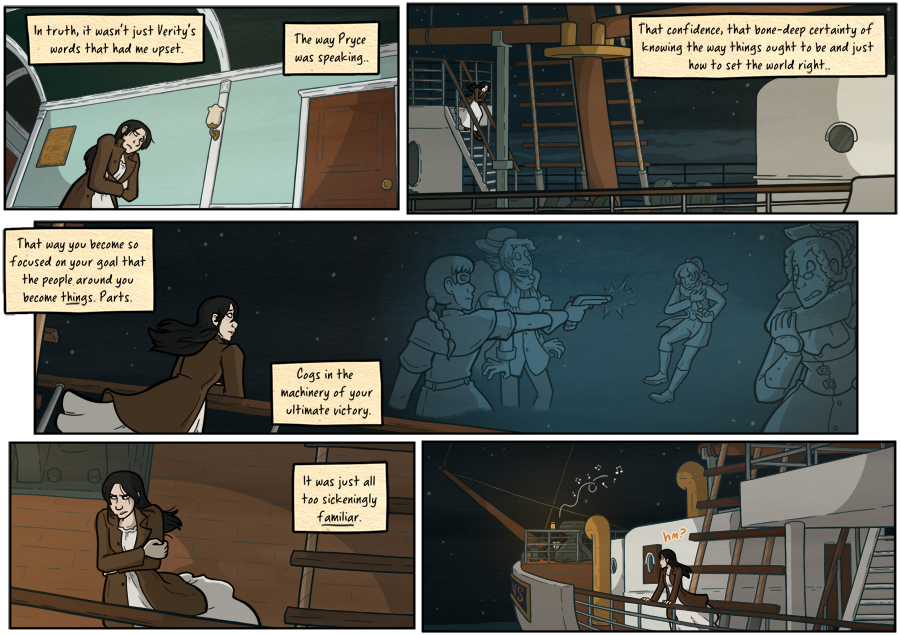
Wow, I'd never really stopped to think about any similarities between them, but it's interesting to see Lei point out the parallels between herself and Pryce. Guess she'd know that mindset better than anyone. (also, great quote in the description)
And unrelated to today's page, I bought an inverness coat the other day, and while I'm not going to say I was drawn to it entirely because it reminded me of Mal, the association didn't hurt : P
A couple years ago I knitted myself a pair of fingerless gloves where I chose the pattern specifically because it was the closest one I'd found to the shape of Mal's gloves, so I'm with you there!
my fingerless wheelchair gloves I partially chose because they look a bit like his!
The fact that Lei can see a parallel between her and Pryce shows that she is truly reflecting on her past behavior and showing regret and disgust. However, I don't think she can truly forgive herself and move on until she apologizes to the people she's hurt. She just hasn't figured that part out yet. (Maybe because she's traveling with someone who is selfish and prideful. :P )
...I wonder if Thea would rather be a musician, or just a wizard who wishes to use music to do non-Grand Plan things.
I suspect Verity is close to the truth there, actually.
[https://www.widdershinscomi...](https://www.widdershinscomic.com/wdshn/august-10th-2021 "https://www.widdershinscomic.com/wdshn/august-10th-2021")
It would be a perfect misdirect for the awkward uncomfortable one to be the actual mastermind of the effort. As other people pointed out, she actually got her dad to tone it down when he was talking a bit too loosely to Tim and Lei.
Terry Pratchett knows what he's talking about!
I really like the middle panel. Having Lei's memory of that scene from Vanishing Act rendered in grayscale against the sky is extremely effective.
I strongly disagree with Pratchett, if only because he uses sin and then crime as a synonym, as if crime was only decided through morals and not ethics. But again, philosophy was never his forte (I used to be a big big fan, then I read the e-space files and all I got left were pop culture jokes about english and american shows, then I read what he wrote about the real world and all I got was "taxes taxes taxes") - the jokes are still good, tho.
You need the context of the original text here, they're used as synonyms because one of the people in the conversation is a priest who was brought up in an extremely religious country, so he was used to thinking of them as the same thing. The author doesn't necessarily think of it in the same way as the character.
Which is a most frustrating thing for authors. Characters are pieces and remnants of themselves, but they're not avatars.
Well, beside author insertion (what is frequent by Pratchet if I believe the overlapse with what he wrote in lapsus clavi), the fact a quotation is made of the author rather than of the character let the fact sink that dialogue about ethics is even older than Plato... and that they serve the author's intent. In the period where Carpe Jugulum is supposed to take place (I'd say intertewined 18th/19th, the Discworld's Renaissance touch is long gone), the philosophic tradition of fictional dialogue was still strong.
If I may be a pedant, the premise of the dismissal is also faulty.
Say I said, "Oh well romance is really simple! If you like someone, you should be together with them!" Then I believe someone would be correct to disagree, and believe that it's more complicated than that. According to this quote, that just means they don't like the truth.
Lots of things are More Complicated Than That. You can oversimplify anything, really.
I also disagree with this character. Obviously dehumanising someone is an evil act. But it's not the only one, and it's not the foundation of all other evil acts. Hell, some evil acts, some maliciousness, requires one's victim to be human. You can't torture a cog.
Well, that depends on your point of view. I suspect Pratchet's character would retort that you can't torture a human either, if you see them as really human. Only when they're a thing to be dealt with can you perform such acts on them.
I haven't actually read Carpe Jugulum, so I'm only guessing on that score. But even if I'm correct, that doesn't mean you're wrong here. It means you have a different point of view. And if you reach the same conclusion, then the difference seems to be merely academic. I suspect you and Pratchet's character would agree far more than not, at least regarding the bigger picture.
You're right about the character saying that you wouldn't torture a human until you see them as a thing, but I don't know if Me-me or anyone else in real life would get along with her.
Granny Weatherwax is one of my favorite characters in Discworld, but she can be fairly accurately described as extremely strong-willed, so much to where she never takes "No" for an answer. She's very uneducated, but she won't let anyone but herself think that she's never wrong. About anything.
In short, she's very good at acting knowledgeable about things she knows nothing about, and at making others agree with her even if they know better.
She does have her own, self-made version of psychology, called "headology", which is described as "if a man goes to a psychologist saying that there's monsters chasing him, the psychologist will attempt to convince him they're not real. If he goes to a headologist, the headologist will give him a poker and a chair to stand on while he fights them off." It makes her a very good village witch, but not so good at everything else.
Oh yeah, and she has so much confidence that she could run the Good Intentions for a hundred teleports easily.
At the risk of being pedantic, there's a pretty wide gulf between getting along with someone and agreeing with their ethics. Beyond that, I'll let the matter rest. I've read quite a bit of Disc World, but only one of the Weatherwax books, so you probably know her character better than I do.
It's not like there's really a consistency in her ethics, beside the big things. The character isn't even the same. Pratchett believed in getting better with time, so he allowed himself to lift a bit of continuity. So you choose your Granny, and choose your morals.
No character in Discworld is Terry Pratchett (except maybe the Discworld's creator in Eric') and each character is made up.
Pratchett wasn't exactly Mr. Tulip or Mr. Pin (characters from The Truth) nor was he Foul Ole Ron, nor was he a Vimes or a Vetinari or a Granny Weatherwax.
Pratchett's characters were, variously, people to live up to; people to laugh about; warnings not to be that person. This is a huge generalisation but it is a good point to start with.
To live up to Granny Weatherwax you need to have massive self assurance and an old fashioned black-and-white morality. That's because, basically, that's what drives Granny Weatherwax. In Carpe Jugulum her Heroes' Trial involves reversing the current of vampirism to weatherwax them and, when she was saying those words, she was in the process of doing that.
Granny Weatherwax does understand the difference between morals and ethics. I'm amazed you can't see that. Morals is the ideal of the perfect life. Ethics is coping with the Real World as you try (and perhaps fail sometimes) to live up to that ideal. Granny Weatherwax, maysherestinpeace, would never have got that wrong, so I have to ask what do you mean, exactly?
I suspect you're thinking in terms of trolley problems. Granny Weatherwax has faced them, bargaining with Death over a child's life in the finest fantasy tradition. That's gone both ways - she has, at least once, asked Death to take another's life - a cow - and once asked Death to take the child, which might raise eyebrows, because the child was horribly wounded. If she had failed the traditional card game then she would have died. She's faced the trolley problem and risked her life to redefine it. That's ethics.
But she was in the process of reversing the polarity of a vampirism curse. Ethical subjectivity was not what she needed for that. She needed morals, she needed to be certain about what she believed in and who she was.
To say that evil starts with treating people as things is perfectly accurate. People have to live up to being people. Take that responsibility away and you're treating them like things.
People have people rights, just because they are people.
Take either of those away and you're treating them like things. To Granny Weatherwax's black-and-white morality the contrast is very evident. But contrast is a valid way of seeing the world.
Wow, I really didn't intend to start a whole philosophical debate with one throwaway remark about Terry Pratchett...
Oh, Lei. I've been really loving her development in this chapter. So much uncomfortable and painful reflection on her part!
$10 on the mysterious musician being Thea.
Doris.
Who turns out to be the Big Bad
Well if it isn't my old enemies, The Consequences of My Actions and Lingering Guilt.
Sorry to be completely unrelated...
But wow, I didn't know Widdershins was still running!
I'm going to start reading it again. Been a fan of Kate's work since early Darken. :)